



Washington Governor Creates New Fraud Prevention Office, Plans Broader False Claims Law
Washington Gov. Bob Ferguson is creating a new fraud prevention office and plans to expand state laws against fraud involving public funds.
· All Seattle News Desk
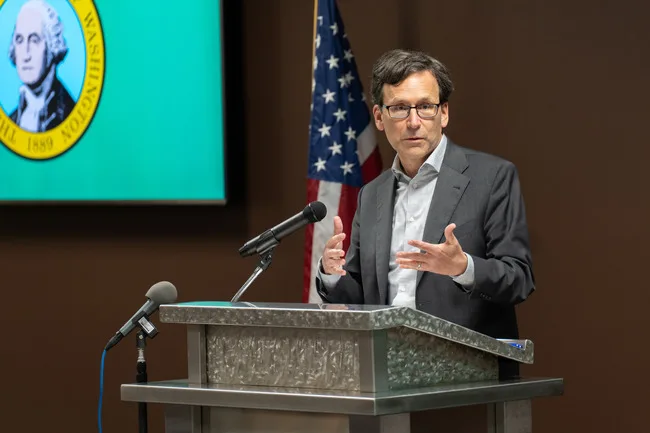
Washington Gov. Bob Ferguson has signed an executive order creating the state’s first Chief Fraud Prevention Officer and a statewide workgroup to strengthen fraud prevention, oversight, and accountability. He also plans legislation expanding the state’s False Claims Act beyond Medicaid.
3. Full description
OLYMPIA, Wash. — Washington Gov. Bob Ferguson has signed an executive order establishing the state’s first Chief Fraud Prevention Officer and a new statewide workgroup aimed at improving the prevention, detection, and investigation of fraud involving public funds.
The initiative is intended to strengthen oversight of health and human services programs and improve coordination among state agencies. Ferguson said protecting public resources is especially important as Washington faces budget pressures and reductions in federal funding.
New fraud prevention officer
The Chief Fraud Prevention Officer will coordinate fraud prevention, detection, investigation, and recovery efforts involving health and human services programs administered by state executive agencies.
The agencies include the Washington State Health Care Authority and the departments of Health, Social and Health Services, Labor and Industries, and Children, Youth, and Families.
According to the governor’s office, the new position will focus on improving program integrity, protecting federal funding, and identifying opportunities to prevent fraud before it occurs. The administration intends to carry out the work using existing resources.
The position will work alongside the Washington State Auditor’s Office, which investigates fraud allegations and whistleblower reports, conducts performance audits, and provides guidance and training to public agencies.
State Auditor Pat McCarthy welcomed the initiative, saying that fraud prevention and detection efforts need greater attention across government.
Statewide workgroup to coordinate efforts
The executive order also establishes the Public Funds Fraud Prevention & Accountability Workgroup, made up of representatives from the governor’s cabinet agencies. The group will be co-chaired by the Governor’s Office and the Office of Financial Management.
The workgroup must develop a statewide fraud prevention and accountability framework by June 30, 2027. The framework is expected to address fraud prevention, detection, reporting, investigations, recovery of public funds, and accountability.
The group will also consider recommendations for changes to state laws and regulations, contractor suspension and debarment standards, reporting systems, and whistleblower protections.
Another potential initiative is a public-facing accountability dashboard that would track fraud prevention performance, trends, recovered funds, corrective actions, and progress in implementing the new framework.
The executive order further directs the Office of Financial Management, Department of Enterprise Services, Washington State Patrol, and Criminal Justice Training Commission to develop fraud prevention and financial crimes training for state employees.
Governor plans to expand False Claims Act
Ferguson also announced plans to introduce legislation during the upcoming legislative session to expand Washington’s Medicaid False Claims Act to cover false claims against the state more broadly.
Currently, Washington’s law focuses on false claims involving Medicaid. The governor’s proposal would extend coverage to other forms of alleged fraud against the state, including overcharging for goods or services, fraudulently obtaining government contracts, submitting false applications for government loans or grants, and other schemes to obtain public funds improperly.
Under the proposed framework described by the governor’s office, violators could be liable for up to three times the government’s monetary losses, along with civil penalties adjusted for inflation.
Enforcement would rely on private individuals bringing whistleblower lawsuits, commonly known as qui tam actions. People who report alleged fraud could receive a portion of the financial recovery, with the state receiving the remainder.
The legislation has been announced as a future proposal; it has not yet been enacted. Its final provisions will depend on the legislative process.
The executive order establishes a new structure for coordinating fraud prevention across Washington state government, while the proposed legislation would seek to expand the legal tools available to recover money lost through false claims.
Source: Official announcement from the Washington Governor’s Office